Working security means you’re regularly the only thing standing between order and a situation that can escalate fast — often without backup close by. A firearm isn’t always authorized, and it’s rarely the appropriate response to the kind of threats most guards actually face: aggressive trespassers, belligerent drunks, people who need to be stopped but not permanently hurt. A quality stun gun gives you a credible, effective deterrent that doesn’t require a use-of-force report every time someone sees it. The products below are selected specifically for the demands of professional security work — reliability, reach, battery life, and the kind of presence that makes most situations resolve before they start.



Amperage matters more than voltage. You’ll see a lot of stun guns marketed with enormous voltage numbers — 80 million, 100 million, 110 million volts. Voltage gets attention, but amperage is what actually affects muscle function. Look for units rated at 4.5 milliamps or higher. The Bad Ass Metal Stun Baton and the Bouncer both hit 4.9 milliamps, which puts them at the top of the effective range for non-lethal stopping power.
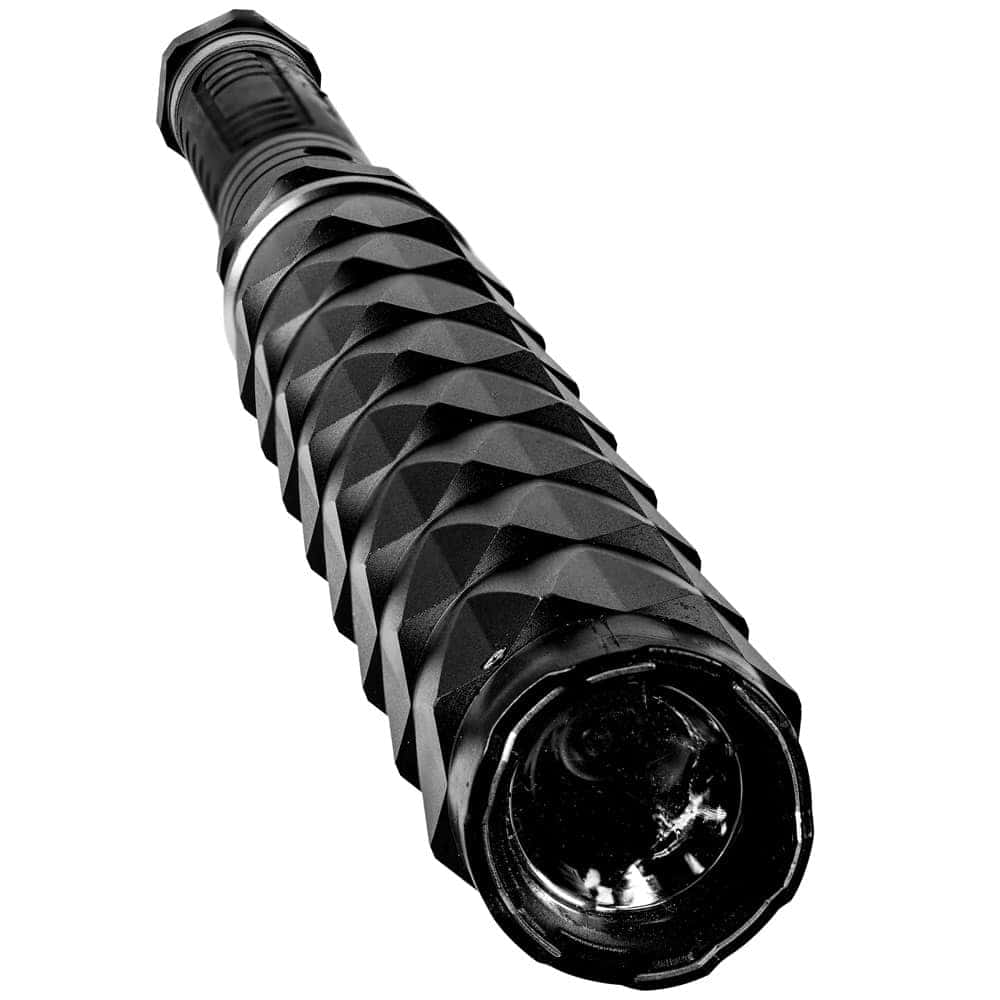
Reach is a legitimate tactical advantage. A handheld stun gun requires you to be within arm’s reach of a threat. A stun baton — like the Repeller or the Bad Ass — gives you 12 to 16 extra inches of standoff distance. In a confrontation that’s escalating, that extra space can mean the difference between controlled deployment and a full wrestling match. For guards working alone or in low-staffed environments, baton-style units are almost always the smarter choice.
The flashlight isn’t a bonus feature — it’s primary. Most security incidents happen in low-light conditions: parking garages, stairwells, after-hours facility checks. A 280-lumen light like the one on the Bouncer is bright enough to temporarily impair vision at close range, which often ends an encounter before any physical contact is necessary. A bright flashlight also signals professionalism and presence.
Rechargeable batteries are non-negotiable for professional use. Battery-powered stun guns are fine for occasional personal carry. For guards pulling 8 to 12 hour shifts multiple times a week, a rechargeable unit is the only practical option. All four products above are rechargeable — plug them in at the end of your shift and they’re ready for the next one.
The disable pin is a real-world safety feature. When you’re physically close to a combative subject, there’s always a risk they grab for your gear. A disable pin wrist strap — standard on the Repeller and available as an add-on for other models — deactivates the stun gun if it’s pulled away from you. This isn’t a marketing feature. It’s a legitimate officer safety consideration.
Most professional security environments will specify where and how you can carry defensive tools, so check your employer’s policy and any applicable state regulations before you decide on a carry method. That said, the general principle is accessibility: a stun gun you have to dig through a bag to find is a stun gun that won’t help you in an actual situation. Belt holsters are the standard for baton-style units. Compact handheld models like the Master Blaster can ride in a holster or clip, depending on your uniform setup.
Deployment in a professional context is usually a deterrent first, contact second. The sound of a stun gun cycling — that distinct electrical crack — is enough to de-escalate a significant percentage of situations without any physical contact at all. Hold it visible, activate it briefly, and let the sound and light do the work. Contact deployment is a last resort after verbal commands have failed and the threat is actively approaching.
Never use a stun gun near flammable materials or in environments where the subject may be using accelerants or oxygen equipment. Stun guns should not be used on individuals who are visibly pregnant, appear to have a heart condition, or are already restrained and no longer a threat. Know your employer’s use-of-force policy and follow it — a stun gun is a tool, not a substitute for good judgment.
Practice handling your unit regularly, including activating the safety and the stun function one-handed. In a high-stress situation, fine motor control degrades fast. If you’ve only ever handled your stun gun in a calm environment, you may fumble it when you actually need it. Make the draw and activation a habit.
A: Legality depends on your state, municipality, and the specific terms of your security license or employer authorization. Many states permit licensed security personnel to carry stun guns, but some require specific certifications or restrict the voltage or type of device. A few jurisdictions prohibit stun guns entirely. Before you carry anything on a security job, check the laws that apply to your location — see our Laws & Restrictions page at https://varietyproducts.com/law-and-restrictions/ for a state-by-state overview, and confirm with your employer and licensing authority.
A: The main difference is reach and presence. A stun baton — like the Repeller Stun Baton or the Bad Ass Metal Stun Baton — gives you 12 to 16 extra inches of distance between you and a threat, which is a real tactical advantage when you’re working alone. A compact handheld unit like the Master Blaster is easier to conceal and lighter to carry during long shifts, but requires you to be within arm’s reach to deploy. Many guards carry both — a baton as their primary duty tool and a compact stun gun as a backup.
A: For professional security work, you want at least 100 lumens — enough to illuminate a dark parking garage or stairwell clearly. The Bouncer hits 280 lumens, which is bright enough to temporarily impair a subject’s vision at close range, often ending a confrontation before any physical contact becomes necessary. Brighter lights also signal authority and professionalism, which matters when you’re dealing with trespassers or aggressive individuals who are testing your response.
A: Both have legitimate roles, and many professional guards carry both. Stun guns require direct contact with a subject, which means you’re already in close range when you deploy — they’re best for situations where someone is within arm’s reach and verbal commands have failed. Pepper spray gives you distance (8 to 20 feet depending on the product), which is useful when someone is approaching aggressively before they’re close enough to grab. The downside of pepper spray in security contexts is blowback in enclosed spaces — gel formulas reduce this significantly. Stun guns don’t have a blowback problem, which makes them preferable in indoor environments like lobbies, stairwells, and enclosed facilities.
A: For professional use, charge after every shift — don’t guess. All four products featured here are rechargeable, and a nightly charge takes less than a few hours. A depleted stun gun is a serious liability in an actual emergency. The Hot Shot and Bouncer models include a battery meter so you can monitor charge levels during your shift. Treat your stun gun like your radio or any other duty equipment: check it at the start of every shift and charge it at the end.
Every security setup is different — duty environment, shift length, employer policy, and state law all factor into the right choice. Reach out through our contact page and we'll help you find the right tool for your specific situation.
Shop All Stun GunsEXCLUSIVE OFFER
Every order – not just your first!
Unlock Your Discount Instantly
Enter your email below and your personal 15% discount code appears right here – no need to check your inbox.
🔒 We respect your privacy. Unsubscribe anytime.
YOU’RE IN!
Use this code on every order
🎉
Here’s Your Code!
Use it now an on every future order.
YOUR DISCOUNT CODE
We also sent this code to your email for safekeeping.