Most break-ins happen fast — the average residential burglary is over in under ten minutes, and most intruders count on you being unprepared, disoriented, or unarmed. A firearm is one option, but it comes with serious legal exposure if you’re wrong about the threat, and it demands a level of training most people never get. Pepper spray changes that equation. A large-capacity fogger or gel formula puts serious stopping power in your hands right now — no license, no range time, no second-guessing. The products below are selected specifically for indoor use, where range, pattern, and formula all matter differently than they do on the street.


Formula strength and type. Not all pepper spray is equal. The number that actually matters is major capsaicinoids (MC) — that’s the active burning compound, not Scoville units, which measure raw heat but not necessarily stopping effectiveness. The Wildfire Pepper Spray Fogger and Wildfire Pepper Gel both carry 1.4% MC, which puts them at the high end of what’s available for civilian use. For home defense, you want the strongest formula you can legally own in your state.
Spray pattern for indoor environments. This is where home defense selection diverges sharply from carry sprays. A stream pattern is accurate outdoors but can miss in the dark or under stress. A fogger pattern — like the Wildfire Fogger — fills a doorway or hallway with enough agent to stop anyone coming through. Gel formulas like the Wildfire Pepper Gel split the difference: they extend range, cling to skin, and reduce blowback, which matters a lot in a bedroom or kitchen where you’re the one breathing the air afterward.
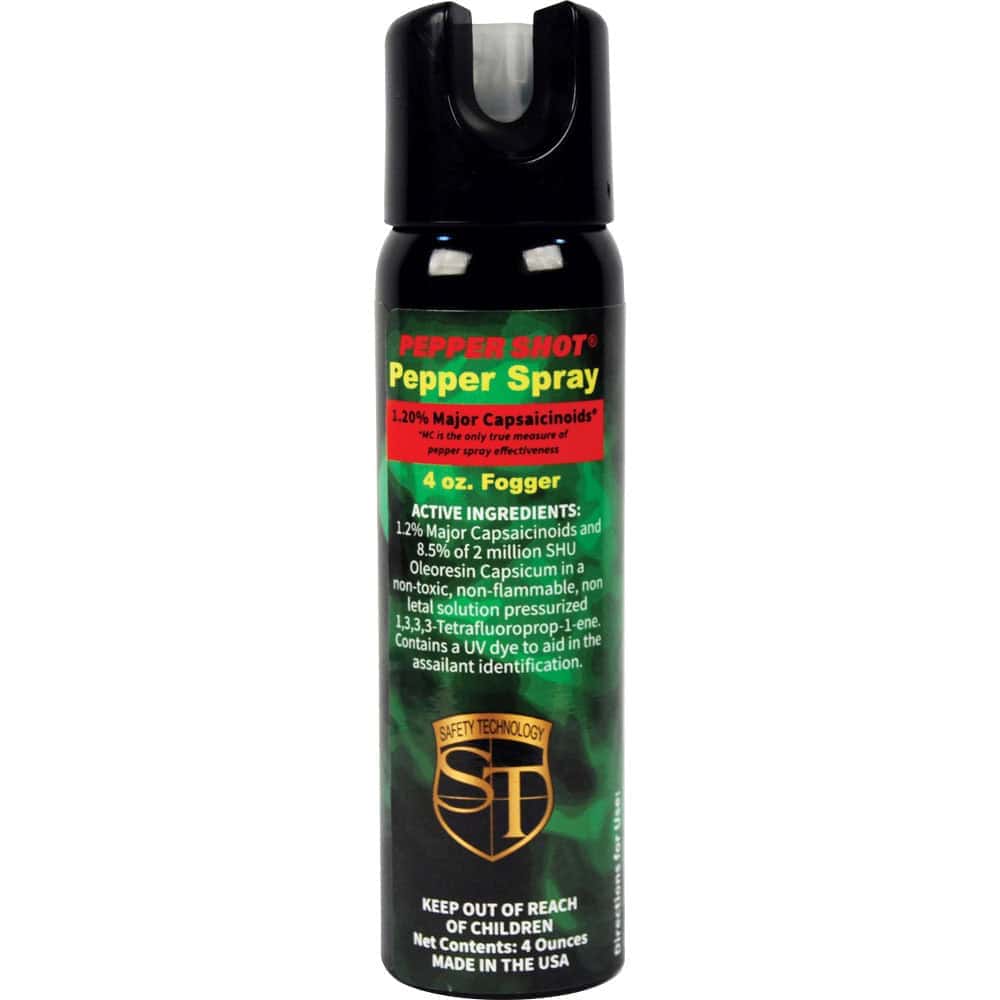
Capacity. Keychain sprays carry 6-10 bursts — fine for a street encounter, not ideal when you’re holding a door or dealing with an unknown number of threats. The Pepper Shot 4oz gives you 18-20 bursts. The Wildfire Fogger comes in sizes up to 16oz. At home, there’s no reason to carry the smallest can available.
Range. Most home defense situations happen inside 15 feet — a typical hallway or entry point. The Pepper Shot 4oz reaches 13-18 feet. The Wildfire Gel reaches 8-15 feet. Either gives you enough distance to deploy before an intruder closes the gap, which is the whole point.
Mounting and staging. Where you store a home defense spray is as important as which one you buy. A can buried in a nightstand drawer does you no good at 2am. The Pepper Shot Tri-Pack includes a wall-mount unit designed to stage your spray exactly where you need it — bedroom wall, near the front door, or in a common area. Stage it like you’d stage a fire extinguisher: accessible in seconds, not minutes.
UV dye. Several products here include UV-marking dye that transfers to an attacker’s skin and stays invisible until hit with a blacklight. It’s not a deterrent in the moment, but it’s useful for law enforcement identification afterward. Look for it — it costs nothing extra and adds a real evidentiary layer.
The biggest mistake people make with home defense pepper spray is buying it and then treating it like a fire extinguisher — stored somewhere safe and rarely thought about. Flip that model. Think through the two or three most likely entry scenarios in your home and stage your spray accordingly. Front door. Back door. Bedroom. Stairwell if you have one. If you have multiple units — like the Pepper Shot Tri-Pack provides — you can cover all of them without moving the spray from room to room.
Deployment indoors requires one adjustment most people don’t consider: ventilation. A fogger like the Wildfire Fogger will contaminate the air in an enclosed space, which affects you too. That’s not a reason to avoid foggers — it’s a reason to understand them. If you deploy in a bedroom, move toward an exit point after firing, not further into the room. Gel formulas reduce this problem significantly, which is why the Wildfire Pepper Gel is worth considering if most of your staging points are in smaller, enclosed rooms.
Practice the reach. Retrieve your spray from wherever you’ve staged it, find your grip, and locate the actuator — do this in the dark, without looking, until it’s automatic. The National Safety Council estimates that motor skill degradation under high stress is significant; tasks that require searching or reading become much harder. Your deployment motion needs to be a reflex, not a decision.
Finally, check expiration dates. Most pepper sprays have a two- to four-year shelf life before the propellant pressure drops and the formula degrades. Mark your calendar when you buy it and replace it on schedule. An expired can of spray is not a home defense tool — it’s a false sense of security.
A: Yes, but the formula and spray pattern matter more indoors than they do outside. A fogger fills a hallway or doorway with enough active agent to stop an intruder before they reach you, while a gel formula like the Wildfire Pepper Gel sticks to attackers on contact and reduces airborne blowback in enclosed spaces. Both approaches work — the choice depends on how enclosed your staging location is and how comfortable you are managing some contamination risk in the immediate area.
A: Pepper spray is legal for civilian ownership in all 50 states, but several states impose restrictions on formula strength, canister size, or who can purchase it. Some states restrict felons from owning it, and a few require buyers to be above a certain age. Before purchasing, check the specific rules for your state. See our Laws and Restrictions page at https://varietyproducts.com/law-and-restrictions/ for a state-by-state breakdown.
A: A fogger — like the Wildfire Pepper Spray Fogger — disperses a wide mist that fills a doorway or hallway, making it very hard for an intruder to push through without full exposure. The tradeoff is that the agent stays airborne in the room, which can affect you as well. A gel formula like the Wildfire Pepper Gel fires in a tighter pattern that sticks directly to the attacker’s skin and eyes on contact, with significantly less airborne dispersal. If your staging point is a small bedroom or enclosed space, gel is usually the smarter call. If you’re covering a larger entry point like a front hallway or stairwell, the fogger’s wide coverage has a real advantage.
A: More than a keychain unit, which typically delivers 6-10 bursts at close range. For home defense, you want a 2oz minimum — ideally 4oz or larger. The Pepper Shot 4oz delivers 18-20 bursts at 13-18 feet, and the Wildfire Fogger goes up to 16oz for serious property coverage. The reason capacity matters is simple: you may need to deploy more than once, across more than one point of entry, or toward more than one person. Running dry is not an option you want.
A: The main advantage of pepper spray for home defense is range — you can deploy it from across a room before an intruder gets within arm’s reach. Stun guns require direct contact, which means letting a threat get close before you can use them. That said, stun guns don’t carry the blowback or air contamination risks that fogger-style sprays do indoors. If your home has tight hallways or small rooms, a stun gun may be worth keeping as a secondary option, but pepper spray with real capacity — like the Pepper Shot 4oz or the Wildfire Fogger — gives you a meaningful distance advantage that contact weapons simply can’t match.
Every home layout is different, and the right spray for a studio apartment isn't the same as what works for a split-level with multiple entry points. Reach out through our contact page and we'll help you figure out the right formula, size, and staging strategy for your situation.
Shop All Pepper SpraysEXCLUSIVE OFFER
Every order – not just your first!
Unlock Your Discount Instantly
Enter your email below and your personal 15% discount code appears right here – no need to check your inbox.
🔒 We respect your privacy. Unsubscribe anytime.
YOU’RE IN!
Use this code on every order
🎉
Here’s Your Code!
Use it now an on every future order.
YOUR DISCOUNT CODE
We also sent this code to your email for safekeeping.